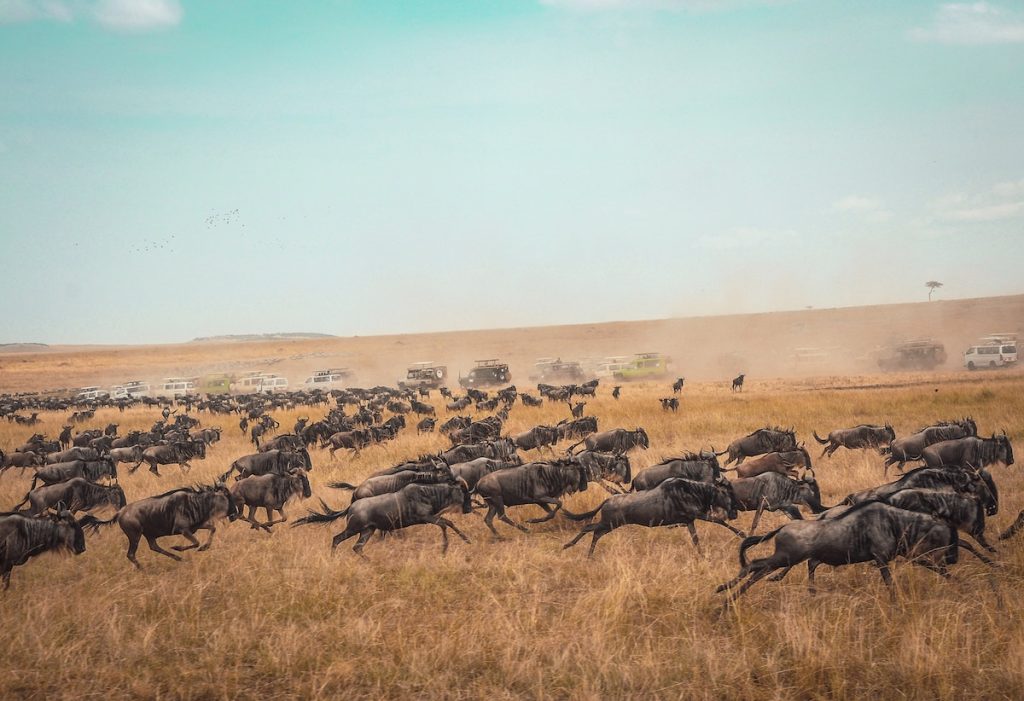
The Great Migration is not an event with a date. It is a continuous, year-round movement of well over a million wildebeest and a few hundred thousand zebra around the Serengeti-Mara ecosystem, and the single most useful thing to understand before you plan a trip around it is this: the herds are always somewhere. The real question is which phase you want to see, and therefore which month — and which part of the Serengeti — to aim for.
Timings shift a little each year with the rains, so treat the following as the reliable pattern rather than a timetable.
December to March: calving on the southern plains
As the short rains green the southern Serengeti and the Ndutu area near the Ngorongoro highlands, the herds gather on the short-grass plains to give birth. The calving peaks in February, when hundreds of thousands of calves are born within a few weeks. It is, for our money, the most underrated time to come: the predator action is constant, the plains are flat and open so sightings are easy, the light is superb for photography, and the crowds are a fraction of what the river crossings draw later in the year.
The herds are always somewhere. The only real question is which chapter of the story you want to watch.
April to June: the long trek north-west
As the plains dry, the herds begin moving north-west in long columns through the central Serengeti and the western corridor. June often brings the first river crossings at the Grumeti, in the west — a quieter, less predictable spectacle than the Mara crossings, and one that far fewer travellers see.
July to October: the Mara River crossings
This is the phase most people picture: the herds massing on the banks of the Mara River in the northern Serengeti and plunging across, against the current and the crocodiles. The crossings run from late July into October. They are genuinely dramatic — and genuinely crowded, because everyone wants the same photograph. Nobody, incidentally, can promise you a crossing on a given day; the herds move when they move.
November: the return south
As the short rains return, the herds turn back south towards the calving grounds, passing through the eastern and southern Serengeti. A quiet, transitional month — and then, in late November, the cycle begins again at Ndutu.
So when should you go?
If you want the crossings, come July to October and accept the crowds. If you want the calving and far fewer vehicles, come January to February. If you want value and green landscapes and are relaxed about exactly which phase you catch, the shoulder months reward you. Our Great Migration Safari is timed and routed to reach the herds wherever they are in the month you travel, rather than sending you to a fixed spot and hoping.
Common questions
What months are the Mara River crossings?
The Mara River crossings in the northern Serengeti run from late July into October, though the exact timing shifts each year with the rains.
When is the wildebeest calving season?
Calving peaks in February on the short-grass plains of the southern Serengeti and the Ndutu area, with hundreds of thousands of calves born within a few weeks. December to March is the broader window.
Can you see the migration all year round?
Yes. The herds are always somewhere in the Serengeti-Mara ecosystem — there is no off period. What changes is the phase: calving, the trek north, the river crossings, or the return south.
Is the calving season a good time to visit?
Very much so. February offers constant predator action, easy sightings on open plains, excellent photographic light and far fewer vehicles than the river-crossing months.